To provide you with a more personalized experience, this website may place cookies on your computer. By accepting cookies you agree to this use of your data under Quantician’s Privacy Policy.
Population Health Trends 2026: Improving Quality Patient Care

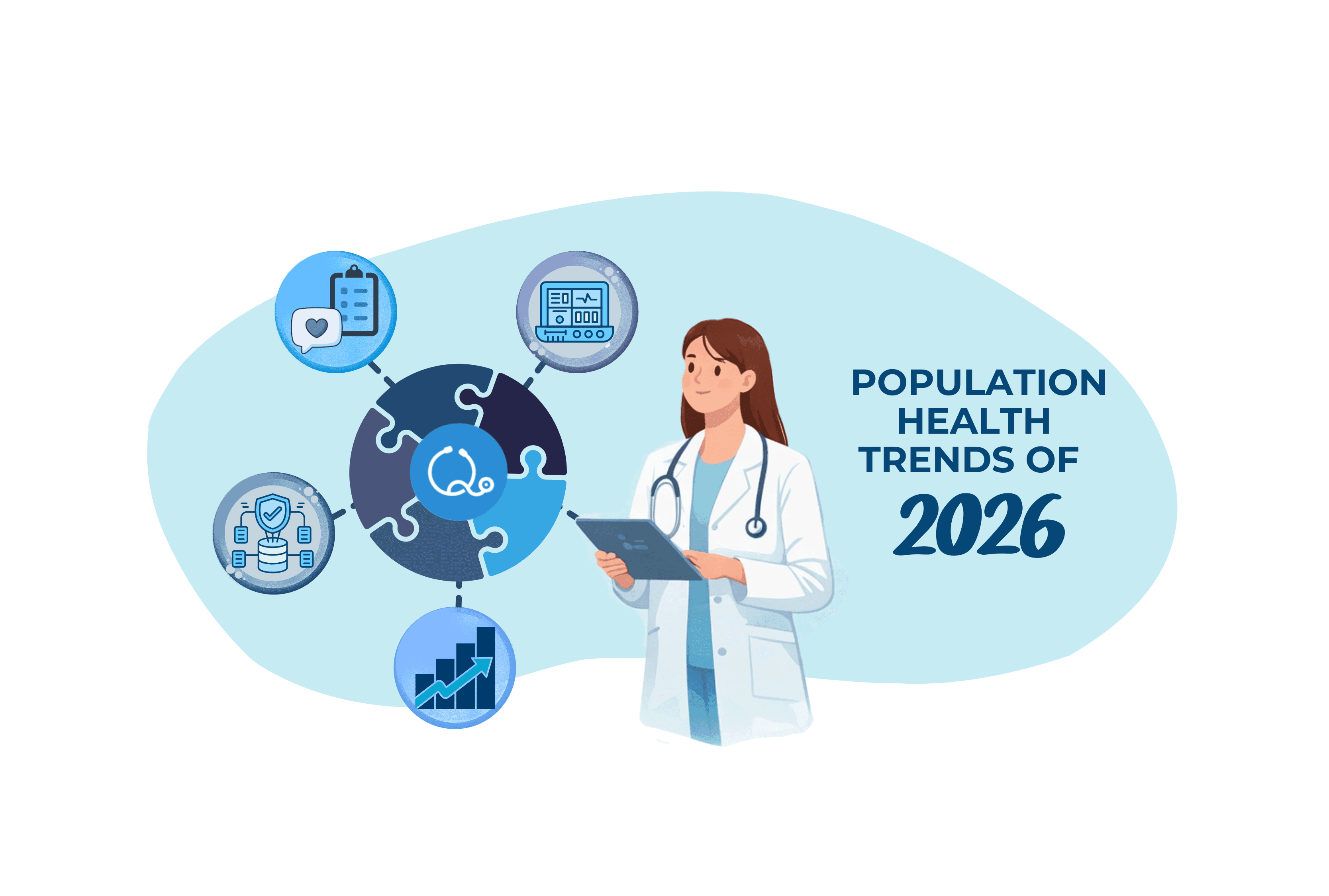
As value-based care matures, population health is transitioning from a supporting function to becoming the primary operating model for healthcare organizations. In 2026, providers will be expected to demonstrate measurable improvement across quality, access, and equity while managing increasingly complex patient populations. Success will depend on how effectively organizations integrate patient engagement, performance data, and quality reporting into a single, scalable strategy.
Patient Engagement Is Now a Core Quality Lever One of the most significant shifts shaping population health in 2026 is the elevation of patient engagement from a “nice-to-have” to a foundational quality driver. Industry research shows that organizations are moving toward personalized, multi-channel communication strategies that support preventive care, chronic condition management, and adherence to care plans.
This matters for quality reporting because engagement directly influences outcomes tied to preventive screenings, chronic disease control, and utilization patterns. In 2026, population health strategies will increasingly prioritize engagement models that close care gaps earlier, improving performance across MIPS, APMs, and other CMS programs.
Data Integration Moves From Retrospective to Real-Time Despite years of investment, fragmented data remains a structural barrier to population-level improvement. Looking ahead to 2026, leading organizations are shifting away from retrospective performance reviews toward near real-time visibility into quality and risk indicators.
This evolution enables earlier intervention for high-risk patients while reducing the year-end scramble often associated with quality submission. Integrated data environments allow care teams and reporting teams to operate from the same source of truth, meaning, aligned clinical action with quality outcomes rather than treating reporting as a downstream task.
Quality Measurement Is Expected to Drive Care Decisions Another defining trend for 2026 is the growing expectation that quality measurement actively informs care delivery. Health system leaders are seeking tools that translate measure performance into actionable insight - highlighting disparities, identifying rising risk, and supporting targeted improvement initiatives across populations.
This represents a shift away from compliance-only reporting toward continuous performance management. Quality data is increasingly viewed as an operational asset, not simply a regulatory requirement.
The Expanding Role of the Qualified Registry As population health strategies become more sophisticated, the role of the Qualified Registry is evolving. In 2026, registries are expected to do more than submit data. They must support validation, trend analysis, and performance transparency across reporting programs.
For organizations navigating growing reporting complexity, the right registry partner serves as both a compliance safeguard and a population health enabler, helping ensure data accuracy while supporting long-term quality improvement.
How Quantician Supports Population Health in 2026 As population health strategies mature, the role of the Qualified Registry is expanding. Quantician supports organizations navigating this transition by aligning quality reporting with broader population health goals.
By offering validated data workflows, performance visibility across reporting programs, and structured support for CMS requirements, Quantician helps organizations move beyond submission toward sustained improvement. In 2026, this capability is critical to ensure data integrity while enabling organizations to monitor trends, address gaps earlier, and support population-level outcomes with confidence.
Looking Ahead In 2026, population health success will hinge on convergence: aligning engagement, data intelligence, and quality reporting into a unified strategy. Organizations that invest in this integration will be best positioned to improve patient outcomes, demonstrate value, and sustain performance in an increasingly outcomes-driven healthcare system.

ACO Performance Strategies for Quality Success
CY 2026 Medicare PFS Final Rule: A Strategic Overview for Registries, ACOs & Reporting Partners