To provide you with a more personalized experience, this website may place cookies on your computer. By accepting cookies you agree to this use of your data under Quantician’s Privacy Policy.
Care Management Programs Are Becoming the Infrastructure Behind Value-Based Performance


For years, healthcare organizations viewed care management programs and quality reporting initiatives as separate operational functions. One focused on patient engagement. The other focused on compliance and reimbursement.
That distinction is rapidly disappearing.
As value-based care models evolve, organizations are recognizing that programs like Chronic Care Management (CCM), Advanced Primary Care Management(APCM), Transitional Care Management (TCM), Principal Care Management (PCM), and Remote Patient Monitoring (RPM) do far more than generate reimbursement. Increasingly, they are becoming the operational infrastructure supporting performance across MIPS, MSSP, ACO REACH, HEDIS, STARS, and other quality-driven models.
Why Care Management Matters Beyond Reimbursement
Most value-based programs share the same goals:
- Improve preventive care utilization
- Reduce avoidable hospitalizations and ED visits
- Strengthen chronic disease management
- Improve patient engagement and adherence
- Lower total cost of care
The challenge is that these outcomes cannot be achieved through episodic care alone.
Patients experience chronic conditions continuously between visits, which is exactly where care management programs create value. CCM, APCM, and related services establish consistent touchpoints outside the traditional clinical encounter, supporting outreach, education, medication monitoring, care coordination, and early intervention before conditions escalate.
In practice, this directly supports the operational goals behind modern quality frameworks.
The Connection Between Care Management and MIPS
Under MIPS, organizations are evaluated across Quality, Cost, Promoting Interoperability (PI), and Improvement Activities (IA). Care management programs influence all four.
Ongoing outreach and coordination help improve preventive screenings, chronic disease monitoring, medication adherence, and follow-up compliance - all of which support stronger Quality performance.
Proactive engagement also helps reduce avoidable utilization, supporting Cost performance through earlier intervention and better chronic disease management.
The connection to Improvement Activities is especially direct. CMS Quality Payment Program defines Improvement Activities around care coordination, patient engagement, and population health management. These are all core functions of care management programs.
Promoting Interoperability also benefits. While PI focuses on electronic information exchange, care management operationalizes that information through real-world patient follow-up and coordination.
Supporting MSSP, ACO REACH, and HEDIS Goals
The same relationship extends across MSSP, ACO REACH, HEDIS, and Medicare Advantage STARS programs.
Centers for Medicare & Medicaid Services (CMS) states that MSSP ACOs are designed to promote coordinated, high-quality care while reducing unnecessary spending. Achieving those goals requires continuous patient engagement infrastructure.
Similarly, HEDIS measures evaluate preventive care, chronic disease management, medication adherence, and patient experience. These areas are strengthened by proactive care management workflows.
Organizations struggling with quality performance often do not have a reporting problem. They have an engagement problem.
How Quantician Supports the Transition
At Quantician, we help organizations navigate the growing intersection between care delivery, quality performance, and value-based reporting.
As a CMS-Qualified Registry, Quantician provides real-time performance visibility, measure monitoring, and actionable reporting insights designed to support success across MIPS, MSSP, MVPs, and broader value-based initiatives.
As healthcare continues shifting toward proactive, coordinated care, organizations that align care management operations with quality strategy will be better positioned not only to report successfully, but to perform successfully.
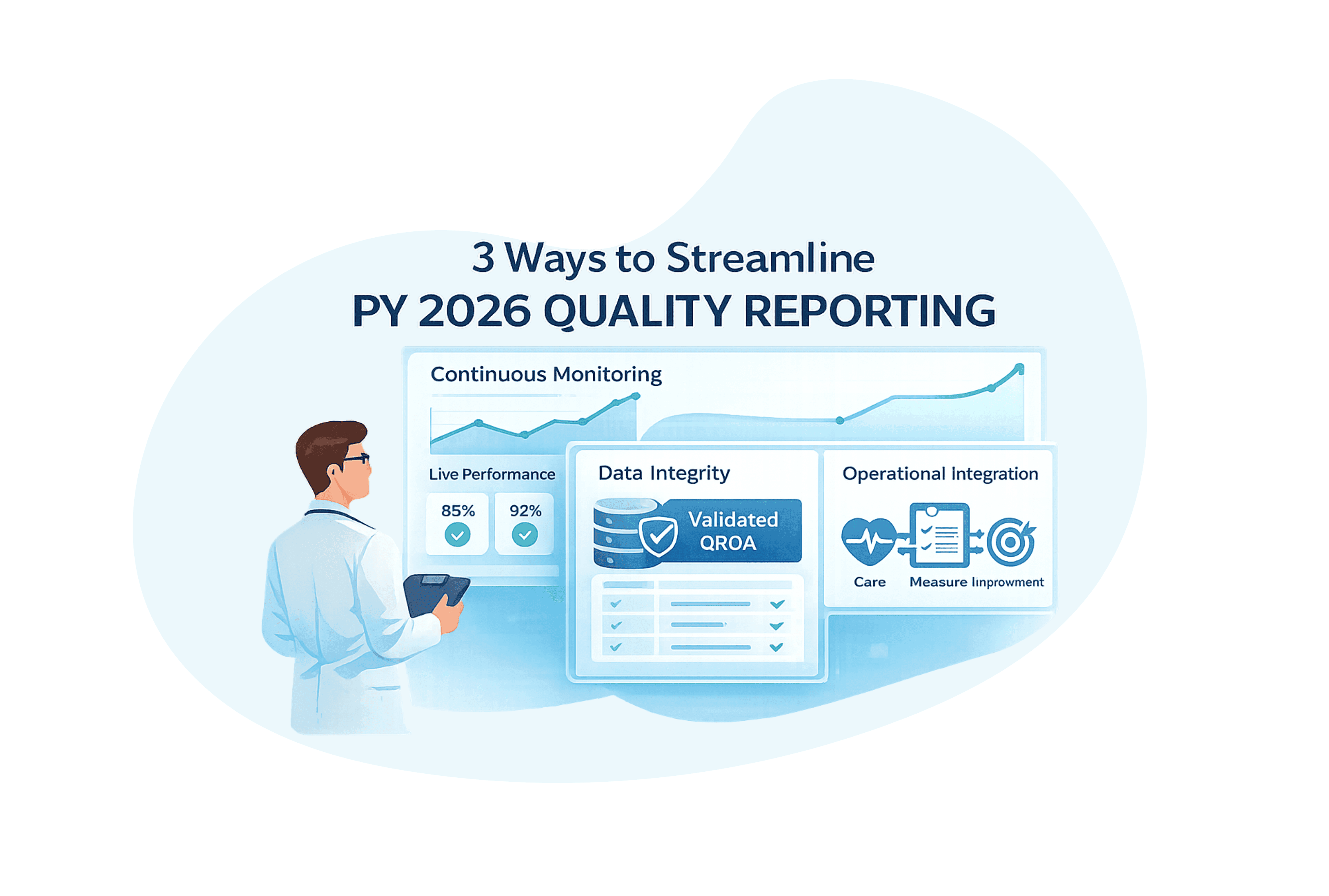
3 Ways to Streamline PY 2026 Quality Reporting

ACO Performance Strategies for Quality Success