To provide you with a more personalized experience, this website may place cookies on your computer. By accepting cookies you agree to this use of your data under Quantician’s Privacy Policy.
3 Ways to Streamline PY 2026 Quality Reporting

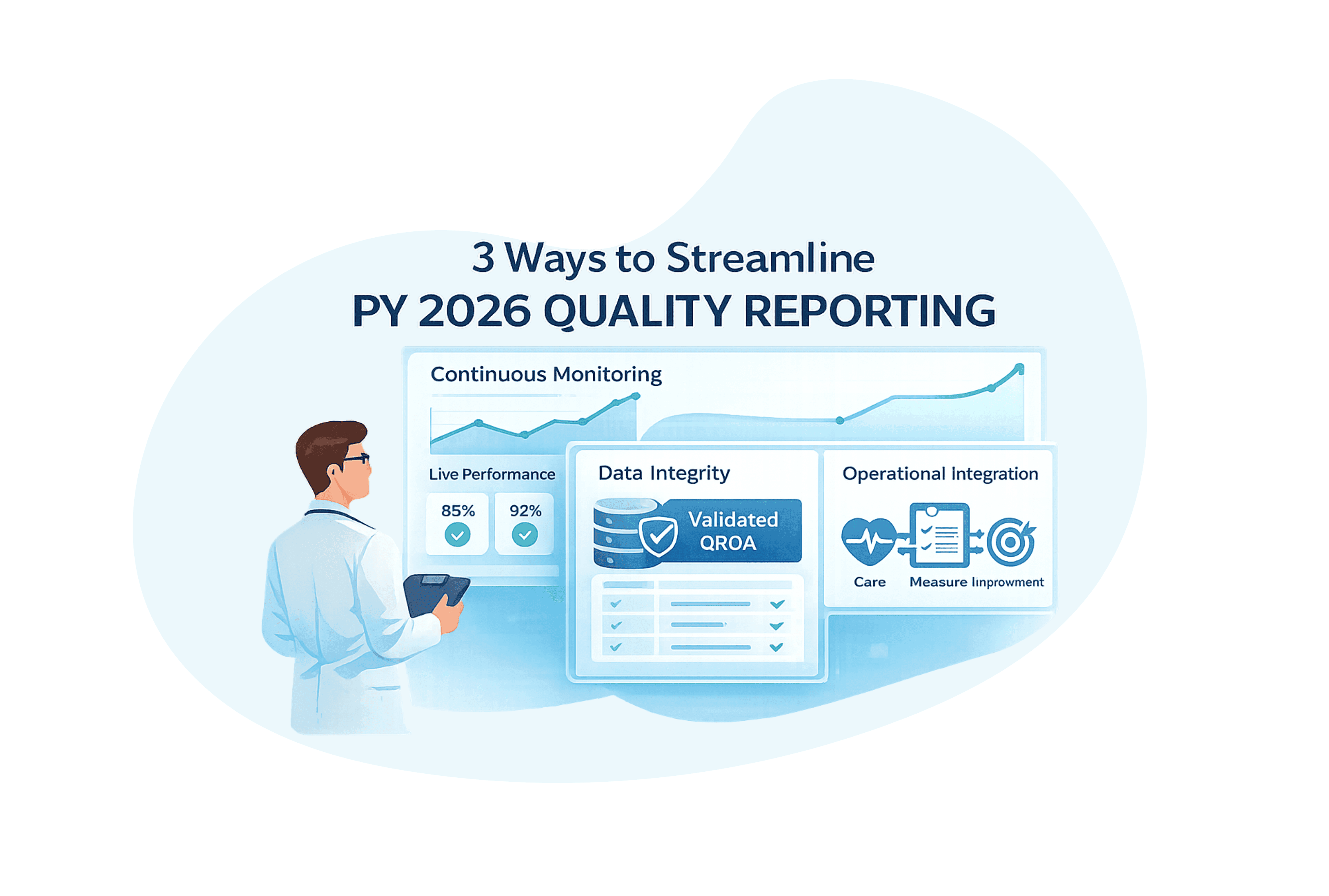
Performance Year (PY) 2026 brings structural stability to the Quality Payment Program (QPP), but not simplicity. CMS finalized updates while maintaining multiple reporting pathways — including Traditional MIPS, MIPS Value Pathways (MVPs), and the APM Performance Pathway (APP). At the same time, measure inventories and benchmarks continue to evolve.
For participating organizations, the challenge in 2026 is less about regulatory change and more about operational efficiency. Streamlining quality reporting now depends on structural discipline rather than last-minute compliance efforts.
Below are three approaches increasingly associated with lower reporting burden and more reliable performance.
1. Replace Year-End Reporting With Continuous Monitoring Quality reporting has historically intensified near submission deadlines, creating cycles of reconciliation and remediation. However, CMS publishes performance benchmarks and program resources with the expectation of ongoing performance management.
Organizations that monitor measures longitudinally greatly reduce late-cycle correction. Common practices include:
- Real-time or near-real-time quality dashboards
- Measure-level trend tracking
- Early identification of denominator expansion or numerator gaps
Continuous monitoring enables corrective action before submission windows open, minimizing administrative compression at year-end.
2. Prioritize Data Integrity Upstream Reporting friction often originates in documentation workflows. Incomplete structured data, inconsistent coding, and fragmented extraction processes introduce variability into QRDA generation and validation.
Healthcare data quality research demonstrates that inaccuracies in structured data directly affect performance measurement outcomes. Even minor documentation gaps can produce measurable score variation.
CMS’s 2026 updates include measure refinements and removals, reinforcing the need for documentation protocols aligned with active specifications. Organizations reducing administrative burden are investing in:
- Standardized documentation tied directly to measure requirements
- Pre-submission validation reviews
- Automated extraction workflows that reduce manual abstraction
Improving upstream data quality typically reduces downstream reporting effort.
3. Integrate Reporting With Quality Improvement Infrastructure Quality reporting increasingly intersects with population health management and value-based contracting. CMS continues aligning reporting pathways to support broader accountability for cost and outcomes.
Organizations that isolate reporting from clinical operations often struggle to translate metrics into improvement. By contrast, embedding quality data into structured improvement frameworks strengthens alignment between reporting and care delivery.
When performance metrics inform care gap outreach, clinician education, and population risk management, reporting becomes an operational feedback mechanism rather than a compliance task.
Looking Ahead CMS has provided relative program continuity for PY 2026 while refining measures and scoring. That stability creates opportunity: organizations can move from reactive submission workflows toward continuous, integrated performance management.
Streamlining quality reporting in 2026 depends on three capabilities: continuous visibility, disciplined data governance, and operational integration. As value-based care matures, structural efficiency is emerging as the defining advantage.
For further analysis on CMS reporting updates and structural readiness for PY 2026, connect with the team at Quantician.
CY 2026 Medicare PFS Final Rule: A Strategic Overview for Registries, ACOs & Reporting Partners
Population Health Trends 2026: Improving Quality Patient Care